Psychosocial hazards learning library · Australian workplaces
Build psychosocial risk capability.
One hazard at a time.
A modular, skills-based learning library for employers. Use a standalone module on one hazard, group modules into a bundle, or deliver a complete workforce training pathway.
In development. Target first release: end of January 2027, subject to change.
Start the conversation
Start with a pilot, not a purchase order.
Tell us about your workplace and what you are trying to fix. We will scope the hazards, the delivery route and the next step, and tell you honestly if the library is not the right fit.
Business Mind Connect is in development. A first release is targeted for the end of January 2027. That is a target, not an assured launch date.
Why employers choose it
Modular by design. Practical by necessity.
One library, many entry points
Standalone modules, selected bundles, or a complete workforce pathway. Employers choose the scope — nothing is locked to a single long course.
Written for employers without a specialist team
Plain language, realistic scenarios and clear boundaries, built for small and medium workplaces across industries.
Built to support your risk-management process
Aligned with recognised psychosocial hazard guidance, including ISO 45003 and Australian codes of practice. It supports your process; it does not replace it.
The gap between early signs and formal action is where the most preventable harm happens.
Most businesses have some form of support available — an EAP, a wellbeing initiative, managers who genuinely care about their team.
Not because support is absent. Because most available supports are designed to activate downstream, after a problem is recognised and formally engaged.
Behavioural change was visible. A team member was clearly not coping. A colleague noticed something was wrong.
But the business did not have the shared language, response confidence, or role clarity to act early within clear boundaries.

Most support arrives after the moment it was needed most.
- Psychosocial incidents that could have been redirected early reach formal escalation or crisis
- Most of the workforce remains outside the reach of existing supports because those supports depend on self-identification and self-initiation
- Regulators and insurers are increasingly focused on whether organisations have active upstream controls, not just downstream supports
- Managers carry the weight of knowing something was off and not acting, without the tools to act differently next time
- Teams lose trust in the workplace when they see colleagues deteriorate before anyone steps in
- The business is exposed, not because it lacked care, but because it lacked capability at the point where it mattered most
Australian WHS obligations around psychosocial risk apply to all businesses, regardless of size. Regulators expect organisations to demonstrate active controls, not just available services. The question is no longer whether to address this gap. It is how.
Training is one part of that answer. It does not identify hazards, consult your workers or implement controls for you.
Most businesses rely on EAP.
But EAP is only one part of the response.
That means most of your team is never reached by the system.

EAP and similar supports are designed to respond once a problem is recognised and someone engages with support directly. They are not designed to help managers recognise behavioural change, support team members, or take early action through clear internal pathways.
In small and medium businesses, that matters even more. Without a dedicated HR or WHS team, managers often carry this responsibility alone, without the tools or confidence to act early.
As a result, emerging issues often sit unaddressed until the situation has already escalated.
Business Mind Connect addresses that gap with modular, skills-based learning at the point where behavioural change is first visible. It does not replace EAP, professional support or management escalation.
That is the upstream gap nothing else you currently have is designed to close.
A stepped approach — combining all three levels
For EAP providers: we are exploring whether selected modules could be licensed for use in client resource libraries. That is an enquiry conversation, not a confirmed product.
The library
A learning library, not a long course.
Every module focuses on one recognised psychosocial hazard and builds one practical skill set. Employers choose the scope. Workers and managers are the learners, and their experience is deliberately brief.
Standalone modules
Short, skills-based modules on individual hazards. Start with the one your team is most exposed to, without committing to a full program.
Selected bundles
A small group of modules chosen around a work context, such as customer-facing roles or distributed teams. Scope is agreed with you.
Complete workforce pathway
The full set of workforce foundational modules, sequenced so every team works from the same language and expectations.

Hazard topics in scope
Examples of the hazards the modules are being built around. Each one is treated as a separate, transferable skill rather than a chapter in a fixed syllabus.
- 01
- 02
- 03
- 04
- 05
- 06
- 07
- 08
- 09
- 10
- 11
- 12
- 13
- 14
Module topics map to recognised psychosocial hazards, including those described in Safe Work Australia’s model Code of Practice. The final scope, grouping and sequence are being confirmed with employers, so we are not publishing a fixed list or count yet.
Explore modules
Leadership layer
A layer for leaders,
not a repeat of the basics.
The leadership layer is designed for owners, directors and managers. It includes access to every workforce foundational module, so leaders share the same language as their teams.
It then adds applied management content. The foundational lessons are not duplicated; the focus moves to what leaders must actually do inside the risk-management process.
Delivery
Designed to fit the way your organisation already learns.
Employers choose and purchase access. Workers and managers complete the learning. Two delivery routes are being finalised, alongside two areas open for enquiry.
Employer LMS / SCORM licensing
Planned delivery option
Host the modules inside your own learning management system through a flexible, SCORM-compatible licence. Scope, sequencing and reporting are agreed as part of licensing.
LearnWorlds individual access
Planned delivery option
Individual learners access modules through a LearnWorlds-hosted environment under licence terms agreed with their employer.
EAP provider resource libraries
Enquiry option only
We are exploring whether EAP providers could license selected modules for their client resource libraries. This is a conversation, not a confirmed product.
Employer customisation and white-label
Enquiry option only
For organisations that need their own scenarios, branding or policy alignment. Feasibility is assessed case by case and is not a confirmed offering.
Delivery options are being finalised. None of these are confirmed products yet, and no pricing is published.
Discuss licensingWhy generic training doesn't always translate to small business
Generic awareness training
Business Mind Connect
Role clarity is not an afterthought.
It is built into every module.

What it is
A modular, skills-based library
Separate bite-sized modules on individual psychosocial hazards, buildable into selected bundles or a complete workforce pathway. Not two long linear courses.
Cross-industry and practical
Built for offices, retail, hospitality, trades, health services and professional practices. The hazards are common to most workplaces; the examples are written plainly.
A shared language across every layer
The leadership layer includes all workforce foundational modules, so managers and workers describe risk the same way and act on it consistently.
Clear boundaries at every step
Each module defines what to do within your role, when to escalate, and where professional support begins. That line is explicit, not implied.
Not counselling or therapy
Learners are not trained to counsel, diagnose or manage clinical presentations, and the content does not ask them to.
Not a replacement for your risk process
Training builds capability. It does not identify hazards for you, consult your workers, implement controls, or guarantee legal compliance.
Not a certification or accreditation
Business Mind Connect is not an accredited qualification and does not certify your organisation against any standard. We do not make certification claims.
Not a diagnostic tool
Knowledge self-reflection before and after each module only. No mental health screening, no clinical scoring, no personal mental health data.
Understanding the case for action,
and how to move forward.

THE CHALLENGE
Psychosocial hazards are present in every workplace, but most small and medium employers have downstream supports in place and limited upstream capability. Behavioural change is visible before it is consistently recognised or acted on. That gap is where preventable harm accumulates, and where regulatory scrutiny is increasingly focused.
WHAT THE LIBRARY IS DESIGNED TO SUPPORT
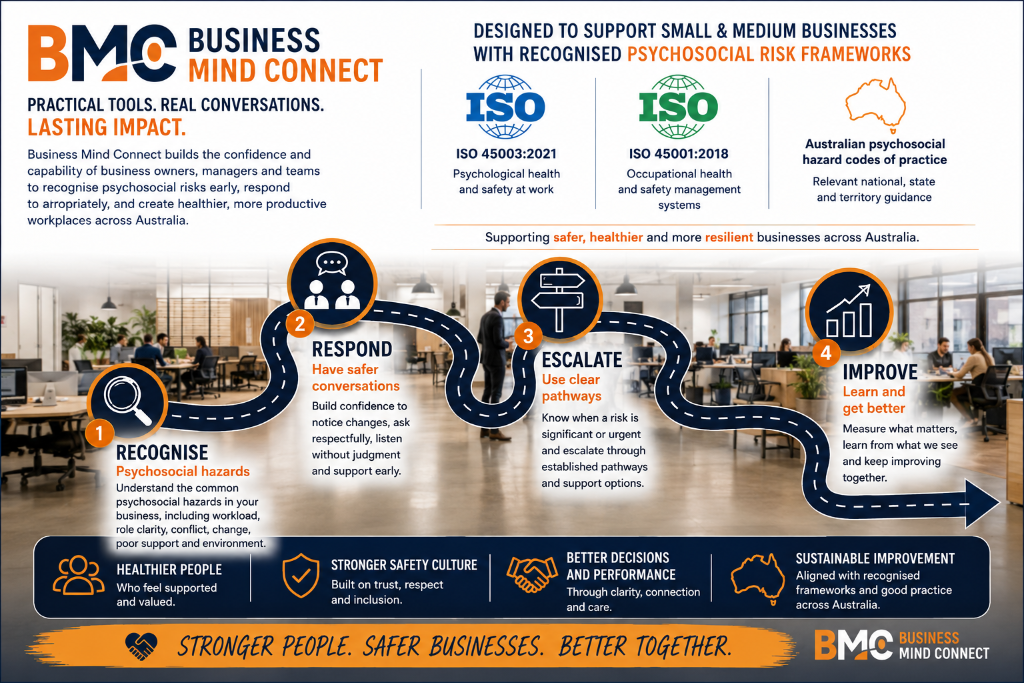
Modular, skills-based learning on recognised psychosocial hazards, aligned with ISO 45003:2021, ISO 45001:2018 and relevant Australian codes of practice. It is designed to build capability across a workforce, not to deliver a single long course. It does not guarantee compliance and does not replace WHS advice, legal advice, HR processes or professional support services.
WHAT CHANGES
Instead of relying on a few people to recognise and escalate risk, managers and teams share a vocabulary, a set of practised responses and clearer escalation boundaries. Downstream supports such as EAP, professional referral and management escalation activate sooner, before people reach crisis point.
WHAT YOU CAN WORK TOWARDS
Consistent capability across sites, shifts and teams. Evidence that managers and workers have completed relevant learning as part of your risk process. More confident consultation, earlier identification and documentation that reflects what your people have actually been trained to do.
THE COST OF NOT ACTING
Continued reliance on downstream supports that reach only a small portion of the team, often after escalation has already occurred. Increasing regulatory exposure as psychosocial obligations apply to all employers regardless of size. Managers carrying a gap in capability they feel but cannot close. Preventable escalations that cost more, in human and business terms, than early action would have.
Training supports your risk-management process. It does not replace actual hazard identification, worker consultation, implemented controls or legal compliance.
Designed to Support Organisational Alignment
Business Mind Connect is being designed to support organisational alignment with recognised psychosocial risk and work health and safety frameworks, including:
ISO 45003:2021
Psychological health and safety at work
ISO 45001:2018
Occupational health and safety management systems
Australian Codes of Practice
Relevant psychosocial hazard codes of practice and guidance
Important: Business Mind Connect does not claim certification to any standard and does not guarantee compliance with any framework. It is designed to support awareness and early action, and does not replace WHS advice, legal advice, HR processes or professional support services.